
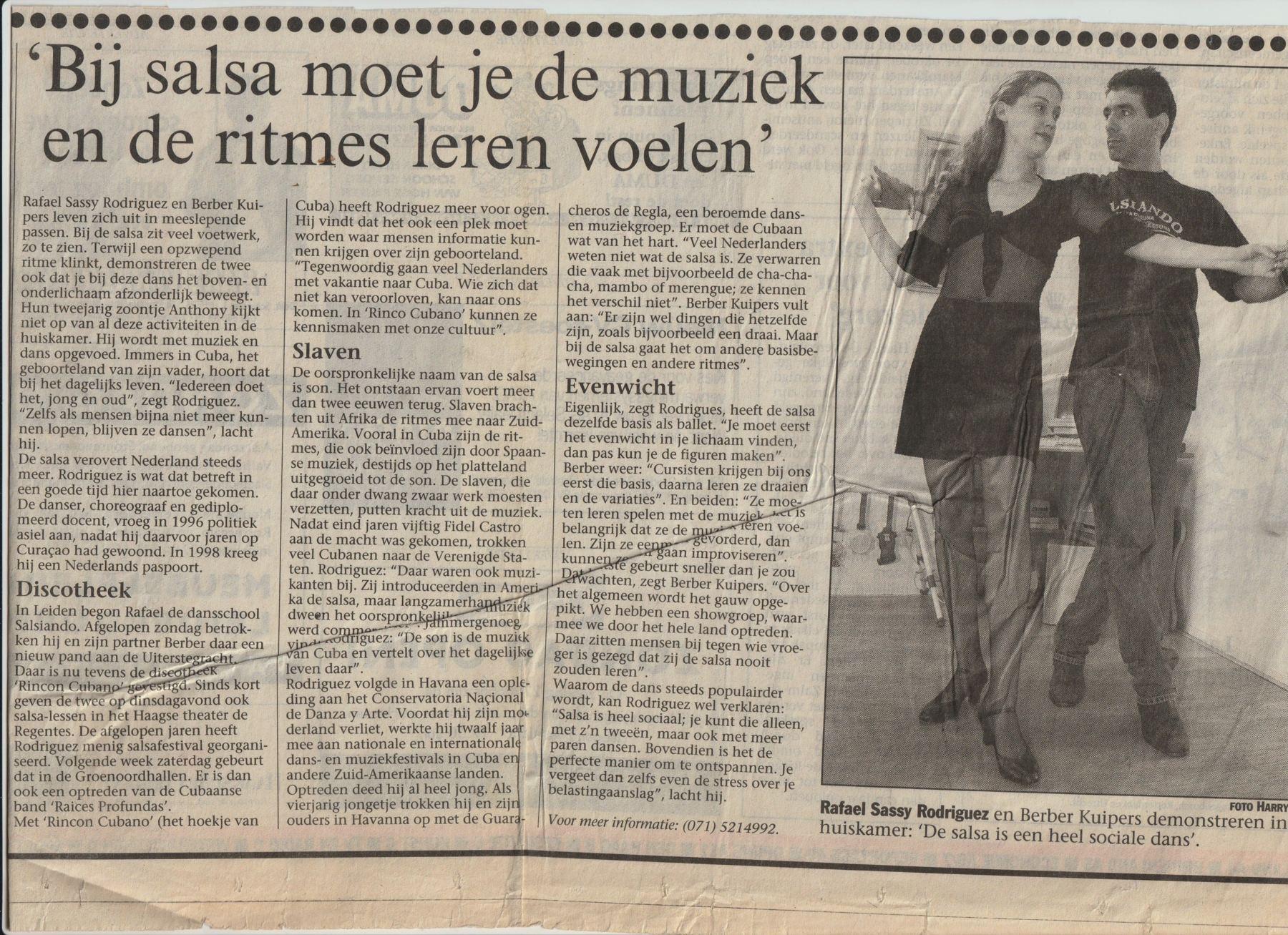
Rafael Sassy Rodriguez and Berber Kuipers let loose in sweeping steps, in the living room, while their two-year-old son Anthony looks on unperturbed. He is being raised with music and dance, because in Cuba that is part of daily life. “Everyone does it, young and old,” says Rafael. “Even when people can hardly walk anymore, they keep dancing.”
Rafael applied for political asylum in 1996, after living in Curaçao for years. In 1998 he received a Dutch passport. In Leiden he started the dance school Salsiando and, with Berber, moved into a new building on the Uiterstegracht, where the nightclub Rincon Cubano also opened: a place where people can get information about Cuba. In addition, they gave salsa lessons on Tuesday evenings at the theatre De Regentes in The Hague.
The article also delves into history. The original name of salsa is son. Slaves brought rhythms from Africa, which in Cuba mixed with Spanish music. After Castro’s takeover, many Cubans moved to the United States, and that is where the name salsa originated.
Rafael compares salsa to ballet: first you have to find the balance in your body, and only then can you make the figures. At Salsiando, students first learn that foundation, then the turning and the variations. “You have to learn to play with the music.”
Why is the dance becoming more and more popular? “Salsa is very social. You can do it just the two of you, but also with more couples. And it’s the perfect way to relax. You even forget the stress about your tax bill for a moment.”
For more information: Salsiando.com